Eurasian Watermilfoil (EWM)
Eurasian Watermilfoil was first documented in Long Lake in 2000, and developing a strategy to deal with this invasive species was one of the main objectives when the Lake District was formed in 2008. Once an invasive species like EWM infects a lake, the best one can hope for is successful management of the plants to keep them from interfering significantly with enjoyment of the lake. Eradication is, unfortunately, simply not possible. Several types of management (as voted on by riparian owners) have been employed in the years since EWM was discovered, including chemical treatment, Diver-Assisted Suction Harvesting(DASH) and hand-pulling.
In February 2013, LLPLD, working with the firm Onterra, secured a Wisconsin Department of Natural Resources (WDNR) grant designed to target Aquatic Invasive Species (AIS) established populations, which allowed the district to continue strategically targeted herbicide treatment, at a lower cost, but with mixed results. In the time since the grant ended in 2017, the DNR has adopted far stricter requirements, and LLPLD has not been successful in getting permission to resume chemical treatment. In 2019 at the annual meeting, owners voted to resume chemical treatment, if it is once again made available.
DASH and hand-pulling are used each summer, and continue to be permitted by the DNR. LLPLD works with an organization called Many Waters to address the worst areas with the suction method (see photo below), and owners are encouraged to try to pull plants from the root if pulling EWM on their lakefront.
Although not easily distinguished from native watermilfoil, the Eurasian variety does have a few characteristics that make it identifiable; click here to learn how to tell the difference, and here to review frequently asked questions about EWM. Unfortunately, the hybrid variety (a cross between the native and invasive milfoil) can only be identified with certainty in a lab. More research must be done before scientists know the growth habit of the hybrid plants.
Click on the links below to read about efforts to manage Eurasian Watermilfoil in Long Lake.
*Onterra 2013 EWM Monitoring and Control Strategy
*Onterra 2014 EWM Monitoring and Control Strategy
*Many Waters 2018 summary of Diver Assisted Suction Harvesting (DASH)
*Notes from Wi DNR representative’s discussion of Eurasian Watermilfoil at 2019 annual meeting
*Summary of study showing the effects of 2-4D chemicals in treating Eurasian Watermilfoil
*Application and supporting documentation to chemically treat Eurasian Watermilfoil in 2020
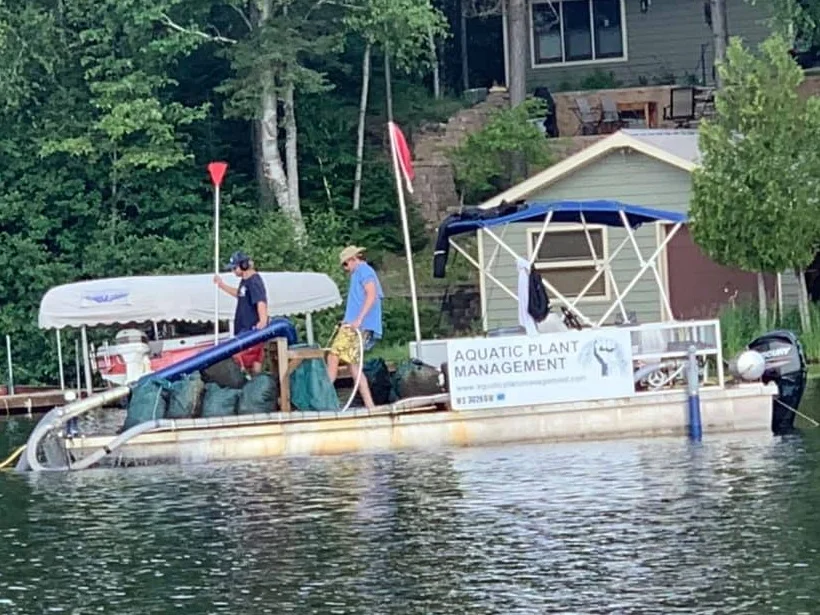
DASH removal of Eurasian Watermilfoil, July 2019